This guest blog is written by Michael Dhanoya, a doctoral candidate in the School of Criminology, Sociology and Social Policy at the University of Leicester. His research focuses on Shiaphobia as a form of religious hate crime, a subject he is well-versed in due to his work supporting victims of various forms of hate crime. The views expressed are the author’s own. You can contact Michael at: md493@leicester.ac.uk.
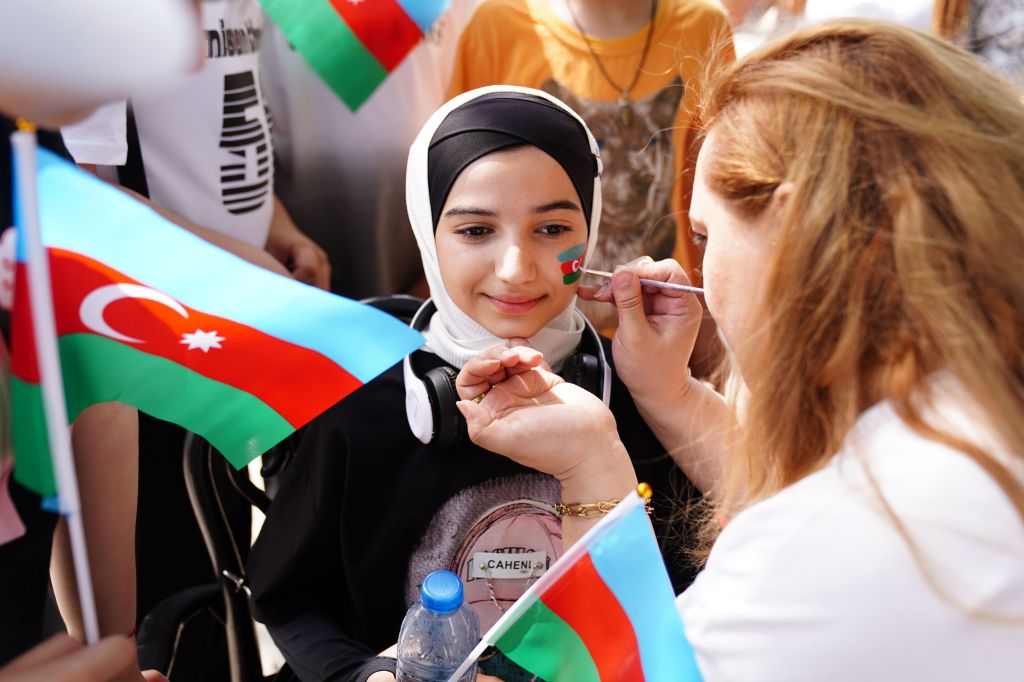
Azerbaijan has become the latest country to place prohibitions on Muslims.
Previously, various nations around the world have made headlines for curtailing the right to freedom of religious expression for their Muslim-minority populations, such as passing prohibitions on the wearing of the hijab, niqabs and burqas in various public places. What makes the edicts passed in the Republic of Azerbaijan (hereafter referred to as ‘Azerbaijan’) on the 6th of October, 2026, all the more newsworthy is that 96% of the nation’s 10+ million population is Muslim. This article discusses the recent legislation passed in Azerbaijan and how such decrees form part of a wider discussion on how Islamophobia is a manifestation of cultural racism.
The Legislation
On the 21st of September, 2026, Azerbaijan’s Cabinet of Ministers adopted Resolution No. 309, which saw the rules regulating school uniforms updated. The legislation prohibits the wearing of additional clothing that contravenes the ‘principle of secularism in education’. Although it initially focused on uniforms worn by pupils, on 6th of October, 2026, they extended the resolution to include attire worn by educators in state-run educational institutions. This legislation has essentially prohibited female Muslim students and teachers from donning the hijab in schools, as evidenced by the images circulated by the nation’s government, concerning what is deemed acceptable manifestations of school uniform. These legislative measures have been met with condemnation. Indeed, demonstrations have erupted nationwide, with protestors rallying around slogans such as ‘The hijab is not an obstacle to education!’ with numerous arrests made as a result of the social unrest.
Unfortunately, this legislation is merely the latest attempt to target the hijab during the twenty-three-year presidential reign of Ilham Aliyev. Indeed, 2010 witnessed a previous attempt to impose prohibitions on the wearing of the hijab in schools (with the rationale again being to preserve the country’s commitment to secularism). This attempt too was met with mass demonstrations. Given public resistance, and since the restriction was never codified in explicit legislation, the directive was enforced inconsistently nationwide. Nevertheless, evidence suggests that the country’s lawmakers have repeatedly sought to construe the hijab as an unwelcome presence in the ‘Land of Fire’.
Islamophobia as Cultural Racism
The explicit targeting of Muslims signals that these legislative measures are an act of Islamophobia. However, whilst Muslims are accustomed to experiencing this phenomenon at the hands of those believed to be non-Muslims, what makes the events discussed in this article all the more startling is that the perpetrators and victims belong to the same faith. President Ilham Aliyev openly identifies as Muslim. Thus, Azerbaijan’s stance towards its Muslim-majority population enlarges our understanding of offender identities in relation to the perpetration of Islamophobic hate. In short, Muslims can also perpetrate Islamophobia.
One may question how this can be so.
In response, and in keeping with another article by the author published on this platform, the author argues that it is important to acknowledge that racism is a multifaceted entity that can be applied to a variety of contexts. Thus, the concept ought not to be linked unwaveringly to notions of biological determinism alone, as it can also be associated with concepts of cultural or religious superiority. Indeed, cultural racism is a phenomenon that draws upon visible identifiers of cultural difference to justify manifestations of hostility and vilification, circulated about and directed towards, those considered as ‘other’. This implies that cultural racism can be perpetrated by one group of people against another if they hold different cultural values, irrespective of sharing a religious identity. Thus, Azerbaijan’s latest legislative decree is a prime example of Islamophobia that is underpinned by cultural racism.
The hijab is seen as contrary to Azerbaijan’s desire to develop an educational system based on the foundational principle of secularism. Underpinning the new legislation is the idea that the nation’s values are being displaced, in favour of the ‘Islamisation’ of the country. By repeatedly attacking this visible symbol of Islam, Aliyev is attempting to construct a ‘normative truth’, at least at the governmental level (given that Shia Muslims constitute a demographic majority in Azerbaijani society), that positions the Muslim-majority population, as ‘others’. The implication is that they are exhibitors of non-native and antagonistic cultural values.
Strangers in their own Home
The argument that Islam is an alien presence, that replaces the non-Muslim and secular culture of a given state, is nothing new. Indeed, various nations around the world are participating in a global drive to curb expressions of Islam, under the pretence of wishing to preserve their native (explicitly non-Muslim) worldviews. Such measures frame Islamophobia as a phenomenon that sees Muslims undergo the process of racialisation, albeit with notions of biological superiority being supplanted by notions of cultural superiority. Unsurprisingly, reports of Muslim communities undergoing this racialisation process typically emerge from those states where Muslims constitute a demographic minority. However, far from having to ‘go back to their own country’, Azerbaijan is a predominantly Muslim state (indeed, the green that forms part of the horizontal tricolour on the state’s flag symbolises adherence to Islam). They are in their own country. Thus, the fact that its citizenry undergoes the very same process of racialisation reveals the truth… that Muslims are not even welcome there.
This guest blog is the intellectual property of © Michael Dhanoya.
The blog site is © Natasha Mulvihill and Criminology Tales, 2026.


You must be logged in to post a comment.